


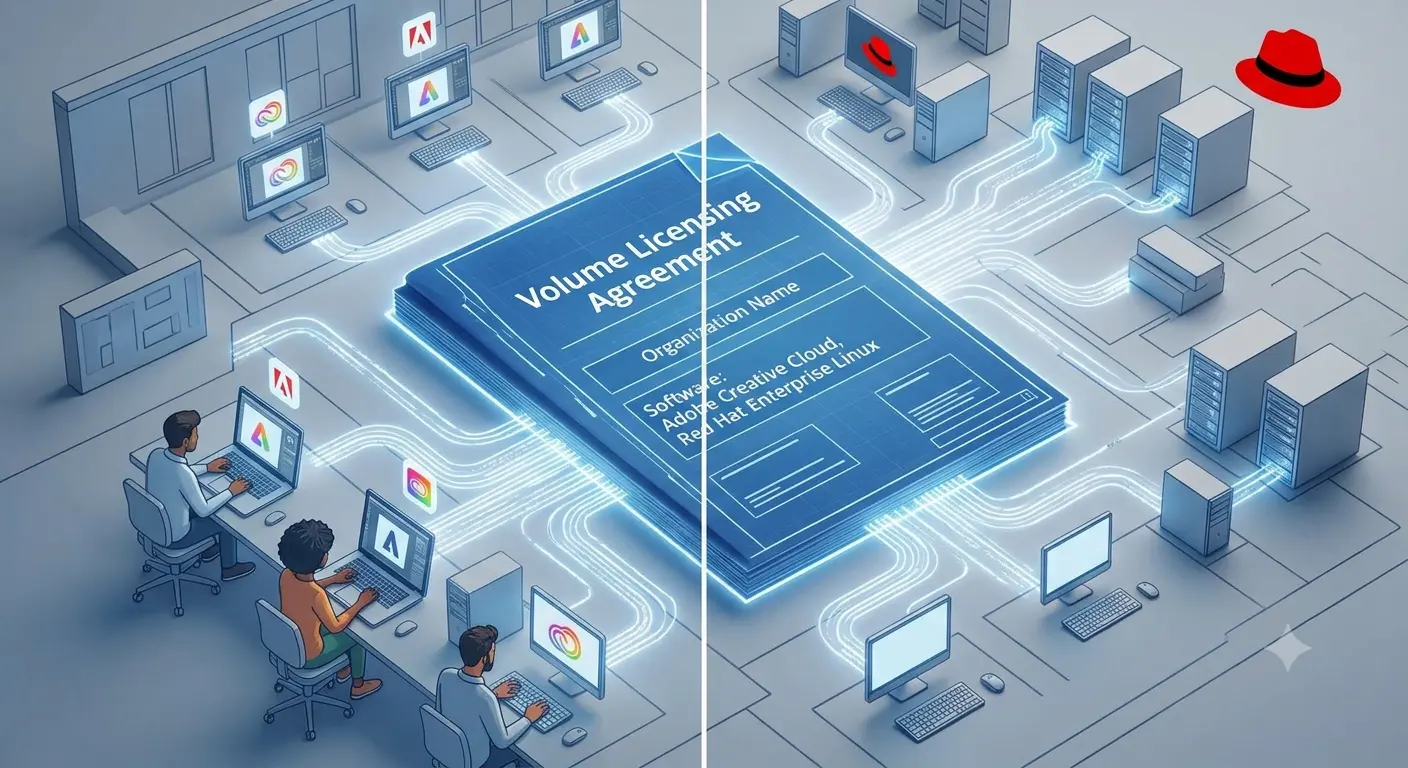
What Volume Licensing Actually Is (and Is Not)
Volume licensing is how organizations buy software in bulk from a vendor’s enterprise channel instead of one boxed product at a time. The vendor — Microsoft, Adobe, Red Hat, VMware, Oracle, SAP, Autodesk, IBM — sets up a contract program (an Enterprise Agreement, a Subscription, a Cloud commit) that lets the customer deploy many seats under one master contract. The customer usually gets:- Lower per-seat price than boxed retail, sometimes dramatically so.
- Centralized management through a vendor portal (VLSC, Adobe Admin Console, Red Hat Satellite, etc.).
- Standardized deployment — keys, installers, and patches come from one source.
- Negotiated terms — payment schedules, true-ups, renewal windows, and audit rights.
The 2026 Shake-Up: Why This Topic Matters Now
The volume-licensing landscape has been fundamentally reshaped over the last 18 months. Four forces are driving the change:- Broadcom’s VMware acquisition — the channel program was rewritten from scratch. Perpetual VMware licenses are being phased out in favor of VCF (VMware Cloud Foundation) subscriptions, with reported price increases of 150–1,200% at the enterprise tier. ChannelDive’s coverage documents the channel reaction.
- Oracle’s per-employee Java licensing model — decoupled license cost from actual software usage, leading to massive cost shifts for enterprises with large employee counts. Block 64’s 2026 licensing reset covers the shift.
- AI feature bundling — Adobe Creative Cloud Pro, Microsoft 365 Copilot, ServiceNow Now Assist, Atlassian Rovo are all being added to existing enterprise agreements at premium tiers. Licenseware’s 2025–2026 price increase tracker puts Adobe’s AI-driven tier restructuring at ~27%.
- The end of perpetual licensing across the board — VMware forced the pattern; Adobe, Autodesk, and Microsoft are following for specific product lines. The perpetual + Software Assurance model is being replaced by subscription + AI add-on.
Microsoft Volume Licensing in 2026
Microsoft runs the largest volume-licensing program in the world. Five contract types are active in 2026:| Program | Type | Best For | Min Seats |
|---|---|---|---|
| Enterprise Agreement (EA) | 3-year, perpetual + Software Assurance | Organizations standardizing on Microsoft | 250 |
| Microsoft Customer Agreement (MCA) | Pay-as-you-go via CSP | Mid-market, 25–500 seats | None |
| Microsoft Products and Services Agreement (MPSA) | Direct, mix of perpetual + subscription | Mixed-vendor organizations | None |
| Open Value (OV / OV-Subscription) | 3-year, true-up annually | Small and mid-size businesses | 5 |
| CSP (Cloud Solution Provider) | Monthly subscription, billed by partner | Any size, subscription-only | 1 |
Adobe Volume Licensing in 2026
Adobe sells its Creative Cloud and Document Cloud products through two volume channels:- Value Incentive Plan (VIP) — the main enterprise program. Annual or monthly subscription per seat, with tiered discounts at 10 / 50 / 100 / 250 / 500+ seats. The newer VIP Marketplace lets approved resellers sell to small and mid-size businesses.
- Enterprise Term License Agreement (ETLA) — a custom-negotiated multi-year contract for organizations 1,000+ seats. Includes central admin tools, custom deployment, and dedicated support.
Red Hat Volume Licensing in 2026
Red Hat uses a unique open-source-derived subscription model. You do not buy RHEL; you subscribe to a Red Hat account that grants access to the binaries, patches, and support. The main programs:- Red Hat Enterprise Linux (RHEL) Simple Subscription — self-service, 1–249 sockets, no contract negotiation, ordered through the Red Hat Hybrid Cloud Console or an authorized reseller. Red Hat Store is the entry point.
- Red Hat Enterprise Linux Premium — adds 24×7 production support, unlimited VMs on a physical host, and access to Red Hat Insights. Negotiated through a Red Hat account team for 250+ sockets.
- Red Hat OpenShift Container Platform — per-cluster or per-vCPU subscription, with annual commit tiers. Required for production Kubernetes.
- Red Hat Ansible Automation Platform — per-node or per-100-managed-node annual subscription, with bundles for enterprise control.
VMware / Broadcom Volume Licensing in 2026
This is the highest-impact volume-licensing story of 2026. After Broadcom’s November 2023 acquisition of VMware, the entire licensing program was rewritten. The new model is centered on VMware Cloud Foundation (VCF), a unified subscription bundle that includes vSphere, vSAN, NSX, and Aria management.| Old Model (pre-2024) | New Model (2026) |
|---|---|
| Per-product perpetual licenses (vSphere Standard, Enterprise Plus, vSAN Standard, Advanced, Enterprise) | VCF Subscription per core (Standard, Pro, Advanced) |
| SnS (Support & Subscription) renewal separate | Support bundled in the subscription |
| Mix and match across products | VCF bundle only — single SKU, single metric (per core) |
| Per-CPU or per-VM metrics | Per-core subscription, minimum 16 cores per socket |
Oracle Volume Licensing in 2026
Oracle’s licensing is famously complex. Three main programs drive enterprise spend:- Oracle ULA (Unlimited License Agreement) — a fixed-fee multi-year contract that grants unlimited deployment of a specific product family (Database, Middleware, E-Business Suite). At the end of the ULA, you certify a deployment count and convert to perpetual licenses at the certified number. Popular for growing estates that want predictable cost.
- Oracle PULA (Promotional Unlimited License Agreement) — a negotiated variant with promotional pricing and discounted support.
- Oracle Java SE Subscription — per-employee, per-year subscription introduced in 2023 after Oracle’s shift away from per-processor Java licensing. Oracle Java is the official page.
SAP Volume Licensing in 2026
SAP sells its ERP and analytics portfolio through three main programs:- SAP HEC (HANA Enterprise Cloud) — managed private cloud, subscription per user / per workload.
- SAP RISE — the 2021-launched bundle for S/4HANA Cloud, private edition, with mandatory migration to a hyperscaler (AWS, Azure, GCP, Alibaba). Per-subscription pricing, multi-year contract.
- SAP Named User Licensing — perpetual or subscription licensing for indirect access scenarios (third-party users, customers, vendors accessing the system). Three user types: Professional, Functional, and Limited.
Autodesk Volume Licensing in 2026
Autodesk retired perpetual licenses in 2016 and sells almost everything on subscription. The main programs:- Autodesk Flex — the consumption-based option launched in 2022. Daily token-based allocation across the Autodesk product family (AutoCAD, Revit, Maya, 3ds Max, Fusion 360). Autodesk Flex is the entry point.
- Autodesk Subscription — multi-year fixed-price contracts for specific products (Industry Collections, AutoCAD, Revit). Named-user per month, with tiers for 1 / 3 / 10 / 25 / 50+ users.
- Autodesk Education — free for students and educators, with full commercial-grade product access.
IBM Volume Licensing in 2026
IBM’s flagship program is IBM Passport Advantage (PPA), the master agreement for the entire IBM software portfolio. PPA includes:- IBM Cloud Pak — containerized middleware (WebSphere, MQ, Db2, etc.) with a per-virtual-processor-core metric. IBM Cloud Pak is the entry point.
- IBM Storage and Db2 — per-TB or per-PVU metrics.
- IBM Security — QRadar, Guardium, Verify, MaaS360 with per-user or per-asset metrics.
Volume Licensing Decision Matrix
How to pick the right program for your situation:| Your Profile | Best Fit |
|---|---|
| 1–4 seats, single product, budget-sensitive | Retail license from WindowsKeyShop |
| 5–24 seats, Microsoft-heavy, US SMB | Microsoft CSP or Open Value Subscription |
| 25–250 seats, mixed products, US mid-market | MCA via CSP partner |
| 250+ seats, full Microsoft standard, multi-year | Microsoft Enterprise Agreement (EA) |
| 10+ Adobe Creative Cloud seats, US creative agency | Adobe VIP or VIP Marketplace |
| 1,000+ Adobe seats, global enterprise | Adobe ETLA |
| 10+ RHEL servers, dev / test | Red Hat Simple Subscription self-service |
| 50+ RHEL production servers | Red Hat Premium negotiated through account team |
| Existing VMware estate, renewal 2026 | Negotiate VCF or evaluate Nutanix / OpenShift Virt |
| Oracle Database, 5+ users, growing estate | Negotiated ULA at 3–5 year horizon |
| SAP S/4HANA greenfield | SAP RISE on hyperscaler |
| Autodesk-heavy AEC firm, 10+ users | Autodesk Industry Collection subscription |
Audit Survival Guide
Every major vendor runs license audits. Microsoft’s SCE (Software Compliance Engineering), Adobe’s GLAC (Global License Audit Committee), Oracle’s LMS (License Management Services), and SAP’s LMA (License Measurement & Analysis) all actively audit customers. The BSA also runs software audit enforcement. The 2026 audit survival playbook:- Maintain a Software Asset Management (SAM) tool. Microsoft SAM, Flexera, Snow Software, ServiceNow SAM Pro, or a custom CMDB. The tool must track every install, every user, every cloud subscription.
- Reconcile quarterly. Match deployment reports to your license entitlements. Catch drift before the vendor does.
- Document the agreement. Store every order, every amendment, every add-on, every email from the vendor in a single, searchable archive.
- Engage a third-party SAM auditor before the vendor does. For organizations above 1,000 seats, an annual third-party audit costs $5,000–$25,000 and is dramatically cheaper than an unfriendly true-up.
- Negotiate the audit clause. Push for 90-day notice, on-site only during business hours, scope limited to specific products, no contractual right to remote scans.
The Cheap Alternative for Small Businesses
For a US or EU small business that needs Microsoft Office, Windows, or Adobe on 1–5 devices, the volume channel is the wrong answer. The minimum commitments and the administrative overhead of managing a Microsoft CSP or Adobe VIP account are not worth the savings at that scale. The cheaper, simpler alternative is a retail license from a discount reseller. WindowsKeyShop sells genuine Microsoft retail keys — the same activation as the Microsoft Store, the same software, the same support, at a fraction of the MSRP. The Office 2024 Professional Plus lifetime key at ~$25 is the headline product: one payment, lifetime activation, no subscription, no true-up, no audit. For Windows, the Windows 11 Pro key and the Windows 11 Home key are the equivalent. For QuickBooks, the Pro Plus 2024 USA and the Premier Plus 2024 USA lifetime licenses are the right answer for any US freelancer or small business owner. Volume licensing is for the enterprise. Retail is for the rest of us.Frequently Asked Questions
What is the difference between volume licensing and subscription licensing?
Volume licensing is about how you buy (in bulk, under a master agreement). Subscription licensing is about how you pay (recurring vs one-time). The two terms get conflated, but you can buy a perpetual volume license (e.g., Microsoft EA with Software Assurance) or a subscription volume license (e.g., Microsoft 365 E3 via CSP). Microsoft’s licensing portal documents both.Is volume licensing cheaper than retail?
Usually yes at 50+ seats, often no at 1–10 seats. The 250-seat minimum on Microsoft EA and the 10-seat minimum on Adobe VIP mean a 5-person team pays the same per-seat as a 250-person team. Retail is usually cheaper for small businesses. The WindowsKeyShop catalog is built for that gap.What happens if a vendor audits you and finds non-compliance?
True-up invoice for the missing licenses, plus back-support fees (typically 20–30% of license cost per year), plus interest. The vendor may also terminate the contract. For Microsoft, a 50-seat shortfall on an EA can mean a six-figure true-up. The BSA runs third-party enforcement for vendors that do not audit in-house.Can I mix volume and retail licenses?
Yes. Many organizations buy Microsoft Office 2024 retail keys for the back office and Microsoft 365 E5 for the executive team. The two are tracked separately. The retail key activates against Microsoft’s servers independently of any enterprise agreement. Office 2024 Pro Plus from WindowsKeyShop is a common example.What is the cheapest volume-licensing program for a 25-person business?
For Microsoft, a Microsoft Customer Agreement (MCA) through a CSP partner. For Adobe, the 25-seat VIP Marketplace tier. For Red Hat, the Simple Subscription self-service path. For VMware, evaluate OpenShift Virtualization or Hyper-V before signing a VCF commit. The Microsoft Licensing portal is the right starting point.Is there a free alternative to volume licensing?
Yes. Open-source software — Linux, LibreOffice, GIMP, Inkscape, Blender, Apache OpenOffice, Nextcloud, Odoo Community, ERPNext — eliminates the per-seat license cost entirely. The trade-off is internal IT overhead and the loss of vendor support contracts. For a small business, the hybrid model (open source for back office, paid retail for critical-path tools) is often the best answer.Need a genuine Microsoft retail license without the volume-licensing commitment? Browse Microsoft Office keys at WindowsKeyShop, Windows keys, and QuickBooks USA licenses. Same activation as the Microsoft Store, instant email delivery, full refund warranty.